
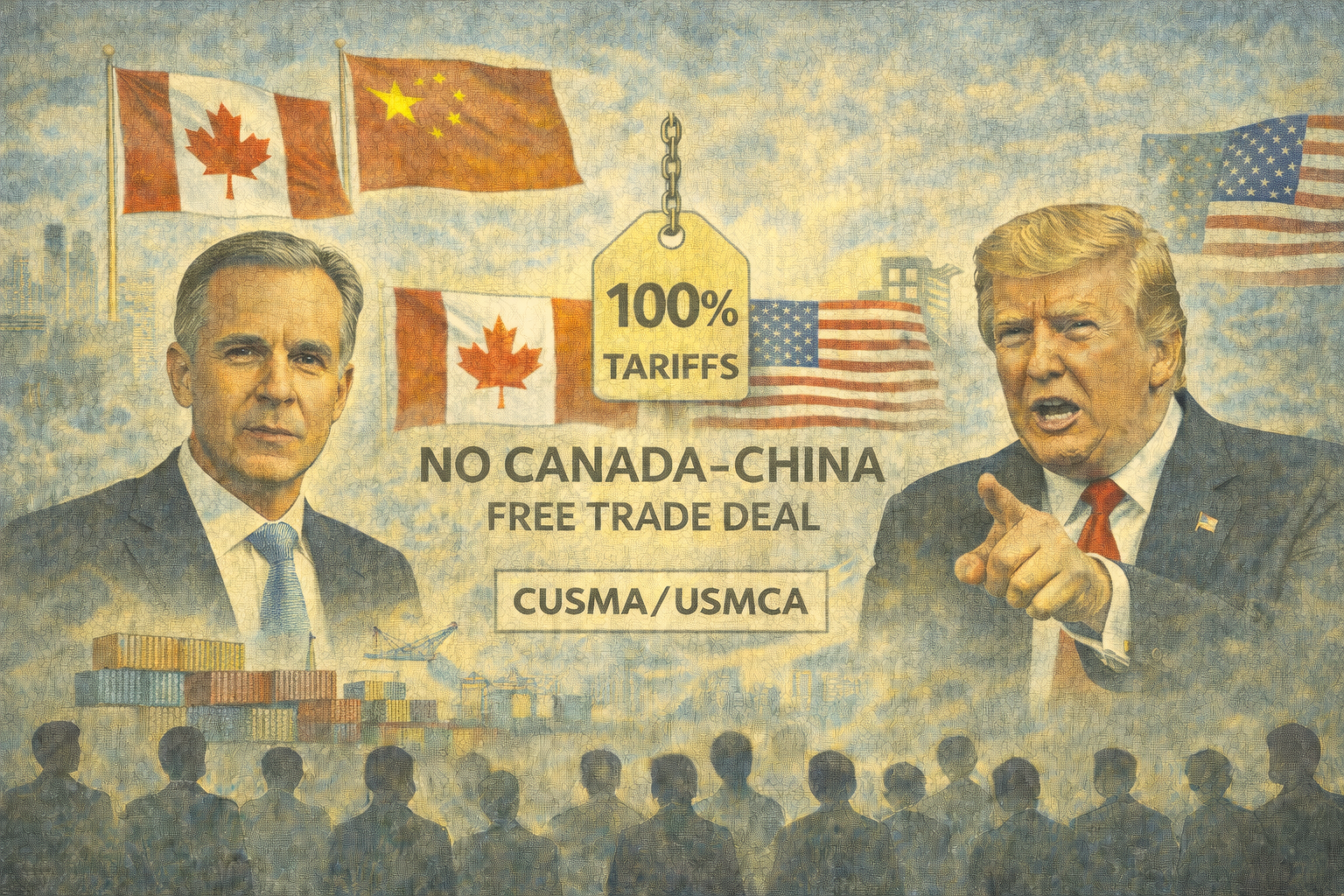
Canada has no plans to pursue a free trade agreement with China, Prime Minister Mark Carney said on Sunday, pushing back against warnings from US President Donald Trump, who has threatened to impose punitive tariffs on Canadian exports if Ottawa deepens trade ties with Beijing.
Speaking to reporters, Carney said Canada would adhere to its obligations under the Canada–US–Mexico Agreement, known as CUSMA in Canada and USMCA in the United States, and would not negotiate a free trade deal with China without notifying its North American partners.
His comments came after Trump said he would slap a 100% tariff on Canadian exports if Ottawa “makes a deal” with Beijing.
“If Governor Carney thinks he is going to make Canada a ‘Drop Off Port’ for China to send goods and products into the United States, he is sorely mistaken,” Trump wrote on Truth Social on Saturday.
Trade agreement constraints and tariff threats
Carney emphasized that Canada’s recent engagement with China does not amount to a free trade agreement and remains consistent with CUSMA rules.
Under the pact, Canada has committed not to pursue free trade agreements with nonmarket economies without prior notification to the United States and Mexico.
“We have no intention of doing that with China or any other nonmarket economy,” Carney said. “What we have done with China is to rectify some issues that developed in the last couple of years.”
Trump’s rhetoric marks a sharp escalation in tensions between Washington and Ottawa, which have already been strained by disputes over trade, tariffs, and broader geopolitical issues.
In August 2025, Trump raised tariffs on some Canadian goods to 35% from 25%.
While most Canadian exports enter the US duty-free under CUSMA, certain products — including steel, copper, and some autos and auto parts — remain subject to tariffs.
Limited China deal draws scrutiny
The immediate flashpoint is a “preliminary agreement” concluded by Ottawa and Beijing on Jan. 16, under which both sides agreed to lower tariffs on selected goods.
Canada will allow up to 49,000 Chinese electric vehicles into its market annually at a reduced tariff rate of 6.1%, after having raised tariffs on such vehicles to 100% in October 2024 alongside the US.
That cap is expected to grow to about 70,000 vehicles over five years.
In exchange, China will reduce duties on Canadian agricultural exports.
Tariffs on canola seed oil will fall to 15% from March 1, down from 85%, while other products — including canola meal, lobsters, crabs, and peas — will be exempt from Chinese anti-discrimination tariffs until at least the end of 2026.
Carney said the agreement was “entirely consistent with CUSMA,” adding that it addressed trade frictions that had built up in recent years.
Escalating rhetoric and geopolitical backdrop
Trump has dismissed that characterization, claiming China is “successfully and completely taking over the once Great Country of Canada.”
He has also warned against Canada becoming a conduit for Chinese goods into the US.
U.S. Treasury Secretary Scott Bessent echoed those concerns, telling ABC News on Sunday that the US could not “let Canada become an opening that the Chinese pour their cheap goods into the US.”
The dispute has unfolded alongside broader geopolitical tensions, including Trump’s push to acquire Greenland and his sharp criticism of Canada’s stance at the World Economic Forum in Davos. Carney has warned against economic coercion by major powers, remarks that drew international attention and praise.
Despite the heated exchange, Carney has maintained that Canada’s approach remains grounded in existing trade commitments.
“What we have done with China is to rectify some issues that have developed in the last couple of years,” he said, reiterating that Ottawa has no plans to pursue a broader free trade pact with Beijing.
The post Canada rules out China free trade deal as Trump threatens 100% tariffs appeared first on Invezz
